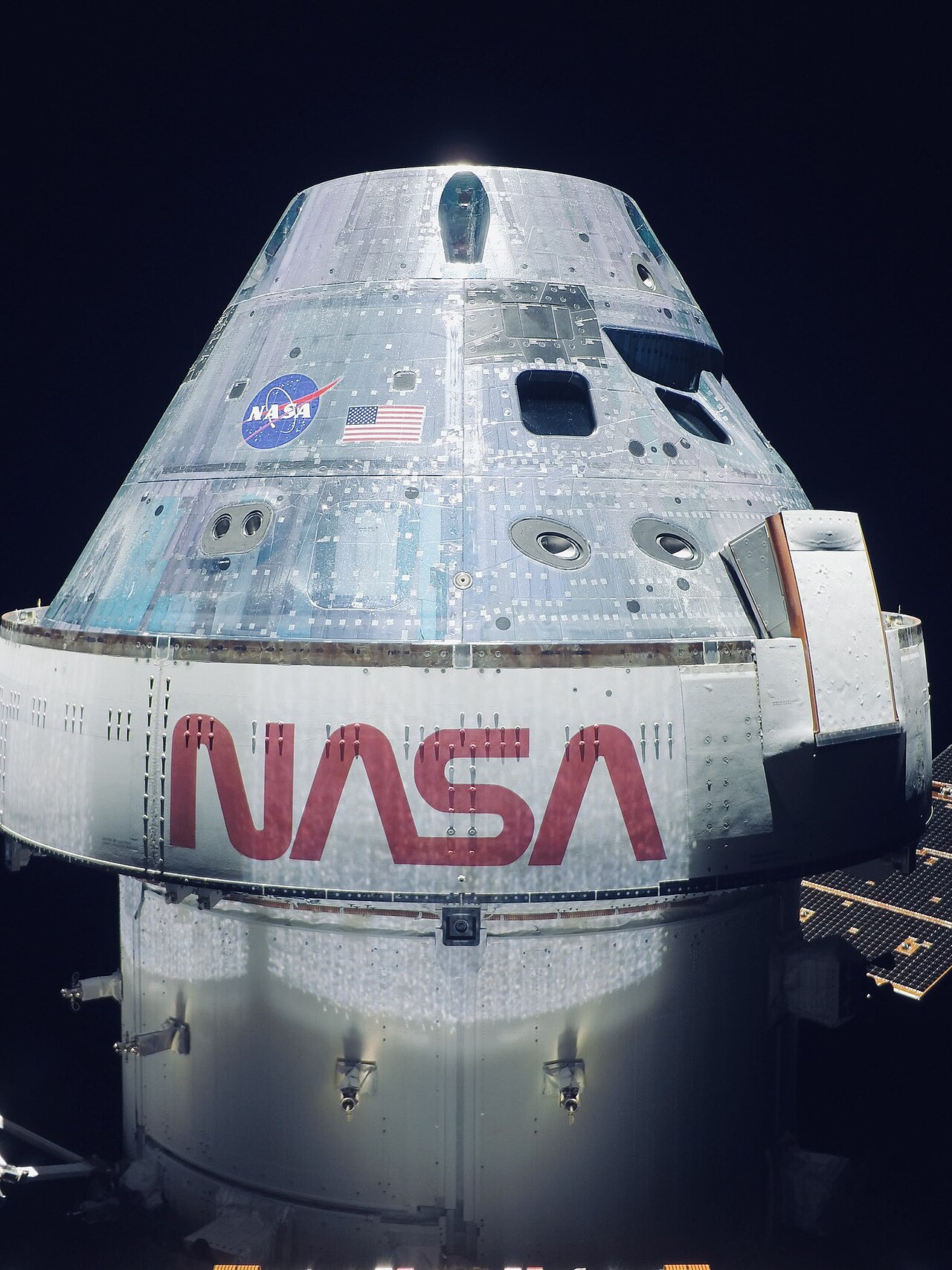
Artemis II
The first crewed flight of the Artemis program: a free-return flyby of the Moon that, in April 2026, qualified the Orion spacecraft under real conditions ahead of future lunar landings.
Objective
Qualify Orion's critical systems in crewed flight: life support, navigation, long-distance communications and atmospheric reentry at lunar velocity. Artemis II did not land on the Moon: it paved the way for the missions that will. Objectives met during the April 2026 flight.
Mission profile
Simplified diagram of the main phases.
Crew
Reid Wiseman, mission commander.
Victor Glover, pilot of the Orion spacecraft.
Christina Koch, mission specialist.
Jeremy Hansen, first Canadian participation in a lunar flight.
Challenges & risks
Within the program
Artemis I
Uncrewed test flight of Orion around the Moon (2022).
Artemis II
First crewed lunar flyby since Apollo, successful in April 2026 (Wiseman, Glover, Koch, Hansen).
Artemis III
Crewed demonstration in Earth orbit (rendezvous/docking), targeted for ~2027.
The mission's vocabulary
A trajectory that brings the spacecraft back to Earth by gravity alone, without a critical maneuver.
A closed trajectory around the Moon, without contact with its surface.
The return phase where the spacecraft crosses the atmosphere at very high speed.
The questions everyone asks
No. It was a crewed flyby, successful in April 2026; the first crewed lunar landing is now assigned to Artemis IV (~2028).
About ten days, from liftoff on Apr 1, 2026 to splashdown on Apr 10.
ESA, via the European Service Module (ESM) that propels and powers Orion.
The confirmed elements of the mission (architecture, primary objectives).
The upcoming schedule and milestones, subject to technical qualifications.
The developments dependent on other building blocks of the program.