Dragonfly
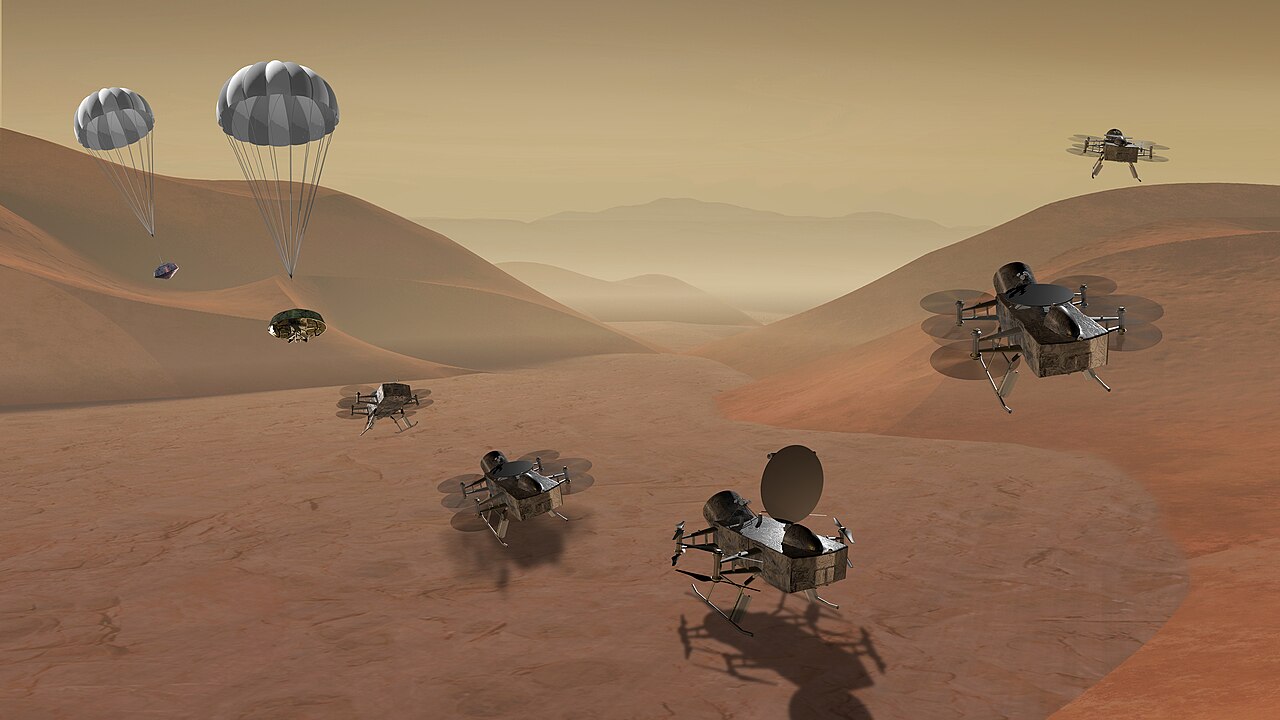
Dragonfly is a nuclear-powered NASA rotorcraft (New Frontiers program, led by the APL laboratory of Johns Hopkins University) designed to explore Titan, Saturn's largest moon. Fitted with eight rotors, the craft will move in successive hops, from site to site, to analyze the surface organic chemistry. Launch is targeted for around July 2028 on a Falcon Heavy, for an arrival at Titan expected around 2034 and a science campaign of about 3.3 years.
Objective
Fly a rotorcraft at the surface of Titan to sample and analyze organic matter there, and assess the moon's habitability. Dragonfly seeks to measure how far prebiotic chemistry, the chemistry that precedes the emergence of life, was able to progress in a world rich in carbon, water and chemical energy. It is not a search for extraterrestrial life, but for its chemical building blocks.
Mission profile
Simplified diagram of the main phases.
Challenges & risks
Within the program
New Horizons
1st New Frontiers mission, flyby of Pluto (2015).
Juno
2nd mission, study of Jupiter from its orbit (since 2016).
OSIRIS-REx
3rd mission, sample of asteroid Bennu returned to Earth (2023).
Dragonfly
4th mission, rotorcraft to explore Titan.
The mission's vocabulary
The set of reactions that, from simple molecules, produce the building blocks of life (amino acids, etc.) before any form of life.
An aircraft whose lift is provided by rotors, like a helicopter; Dragonfly is an octocopter with eight rotors.
Radioisotope thermoelectric generator: it converts the decay heat of plutonium-238 into electricity, with no reactor or moving parts.
The questions everyone asks
Titan's atmosphere is four times denser than Earth's and its gravity seven times weaker: flying there is far easier. A rotorcraft can thus cover tens of kilometers and explore varied terrain, inaccessible to a rover.
No. It studies prebiotic chemistry and habitability, that is, how far the building blocks of life were able to form, without claiming to detect life itself.
It is powered by an MMRTG, which converts the decay heat of plutonium-238 into electricity. It is not a reactor: it is the same technology as the Curiosity and Perseverance rovers.
Titan is about 1.4 billion kilometers away. After a launch targeted for around 2028, it takes nearly six years of cruise, for an arrival expected around 2034.
The confirmed elements of the mission (architecture, primary objectives).
The upcoming schedule and milestones, subject to technical qualifications.
The developments dependent on other building blocks of the program.