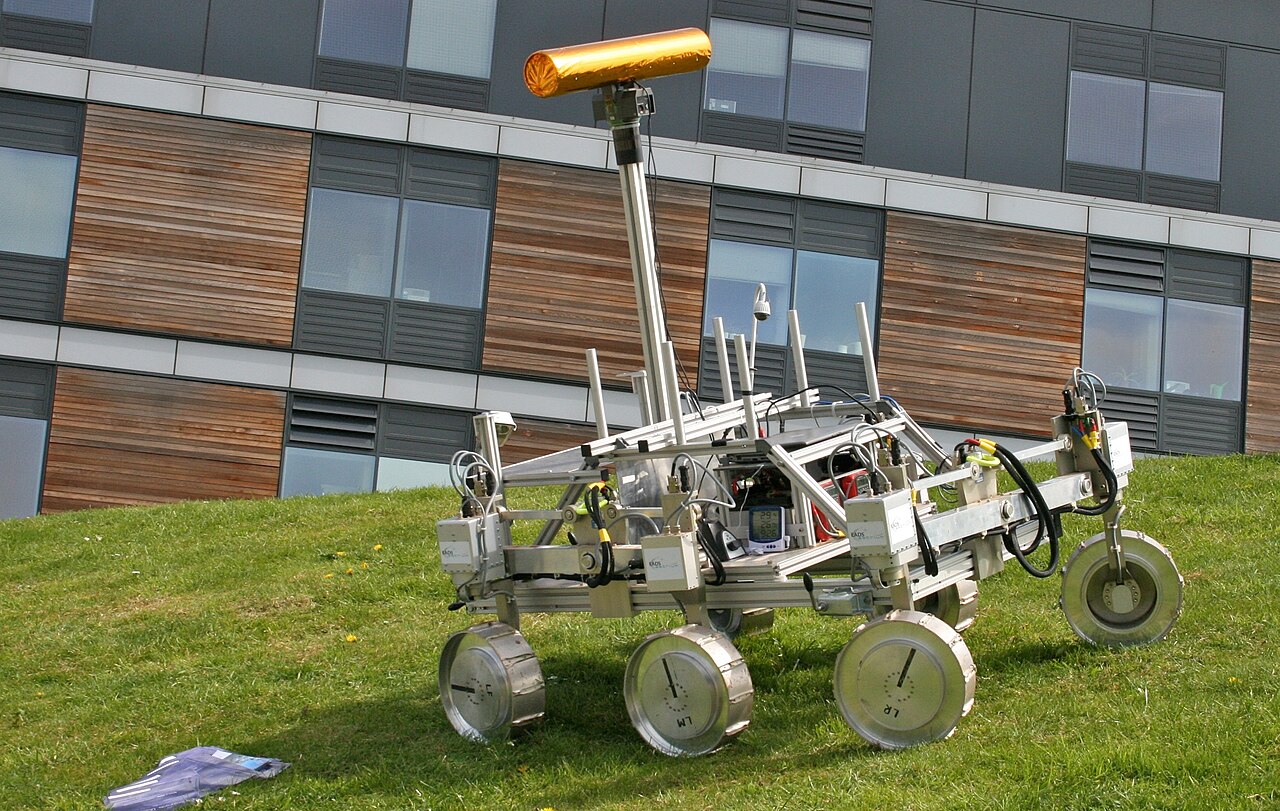
ExoMars Rosalind Franklin
A European astrobiology rover, Rosalind Franklin is to search for traces of life, past or present, beneath the surface of Mars, in the clay-rich plain of Oxia Planum. Its 2 m drill, a first, will reach layers shielded from radiation where organic molecules may have been preserved. First planned for 2022 with Russia, the mission was postponed after the breakdown of cooperation with Roscosmos. ESA is relaunching it with a European lander and a NASA contribution (launcher, braking retrorockets, heating units), for a liftoff targeted at the earliest for late 2028 and a landing in 2030.
Objective
Search for biosignatures beneath the surface of Mars, where organic molecules are protected from ionizing radiation and temperature swings. With a drill capable of reaching 2 m deep and an onboard analytical laboratory, Rosalind Franklin is to establish whether life existed, or still exists, on the planet.
Mission profile
Simplified diagram of the main phases.
Challenges & risks
Within the program
ExoMars 2016, TGO
Trace-gas study orbiter, still active; it also serves as a data relay for surface vehicles.
ExoMars 2016, Schiaparelli
Landing demonstrator that crashed on the surface in October 2016, for lack of a controlled descent.
Rosalind Franklin
The program's astrobiology rover, relaunch targeted around 2028 with a European lander and NASA support.
The mission's vocabulary
A clue, molecule, structure or texture whose origin is best explained by biological activity, past or present.
The discipline that studies the conditions for the emergence, development and survival of life beyond Earth.
The critical sequence during which a vehicle crosses the atmosphere and sets down; on Mars, it lasts about seven minutes, with no possibility of control from Earth.
The questions everyone asks
The launch planned for September 2022 was to rely on a Russian lander and launcher. After the invasion of Ukraine, ESA suspended the mission in March 2022, then ended cooperation with Roscosmos in July 2022. The entire landing system had to be redesigned.
No. It is looking for biosignatures, chemical or structural traces of past or present life, mainly in the subsurface, where any organic molecules are better preserved.
At the surface, radiation destroys organic molecules. By reaching 2 m deep, a first on Mars, the rover accesses protected layers where these clues may have been preserved.
No. Launch windows to Mars open only about every 26 months, and late 2028 is presented as the earliest opportunity. The schedule remains subject to change.
The confirmed elements of the mission (architecture, primary objectives).
The upcoming schedule and milestones, subject to technical qualifications.
The developments dependent on other building blocks of the program.