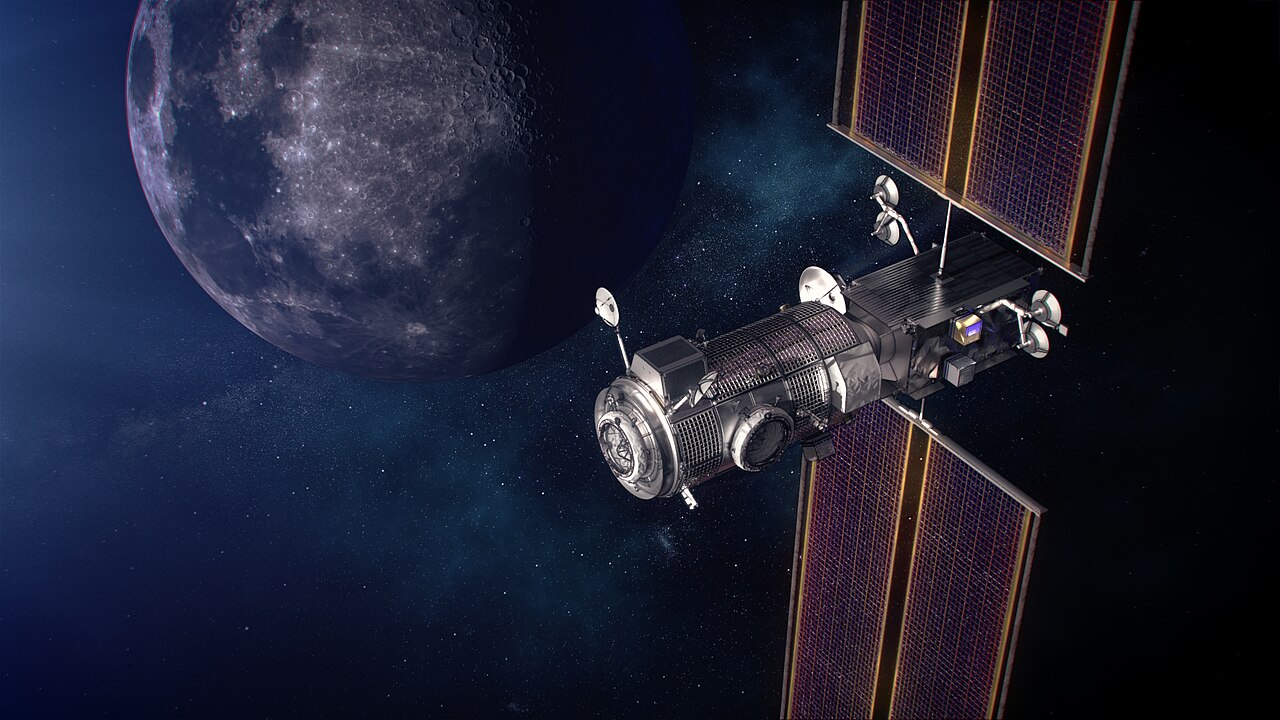
Gateway
A small international station in lunar orbit (NRHO), conceived as a relay point for the Artemis missions. Its first two elements, PPE (power and propulsion) and HALO (habitat), were to depart together on a Falcon Heavy, but on Mar 24, 2026 NASA announced it was pausing the program "as is" to prioritize sustained operations on the surface.
Objective
Establish a habitable waystation in lunar orbit serving as a logistics hub, a communications relay and a deep-space laboratory for the Artemis program. The Gateway is not a surface base: it was to offer a docking point where Orion's crew joins the lunar lander (HLS) before the descent, then prepares the return to Earth.
Mission profile
Simplified diagram of the main phases.
Challenges & risks
Within the program
Artemis I
Uncrewed test flight of Orion around the Moon (2022).
Artemis II
First crewed flight (Orion) around the Moon, successful in April 2026 (Wiseman, Glover, Koch, Hansen).
Artemis III
Crewed demonstration in Earth orbit (rendezvous/docking), targeted for ~2027, the landing moves to Artemis IV.
Artemis IV+
First landing (south pole); was to inaugurate the Gateway assembly, whose role and schedule are under review.
The mission's vocabulary
A highly elongated orbit around the Moon, nearly stable and inexpensive to maintain, chosen for the Gateway.
Power and propulsion module: ~60 kW of solar panels feeding electric thrusters that hold the orbit.
The Gateway's first habitable module: a pressurized command post where the crew lives and prepares the descents to the surface.
The questions everyone asks
Not formally. On Mar 24, 2026, NASA announced a pause "as is" and gave priority to sustained operations on the surface; the hardware already developed (PPE, HALO) would be reassigned and a return of the concept is not ruled out.
No. Unlike the ISS, the Gateway is designed to be visited intermittently during the Artemis missions, and to remain automated the rest of the time.
The NRHO offers a nearly stable trajectory that requires little fuel to maintain, a nearly permanent link with Earth and access to the entire lunar surface over time.
It was the planned rendezvous point: Orion docks there, the crew moves to the lunar lander, then boards again before the return to Earth.
The confirmed elements of the mission (architecture, primary objectives).
The upcoming schedule and milestones, subject to technical qualifications.
The developments dependent on other building blocks of the program.