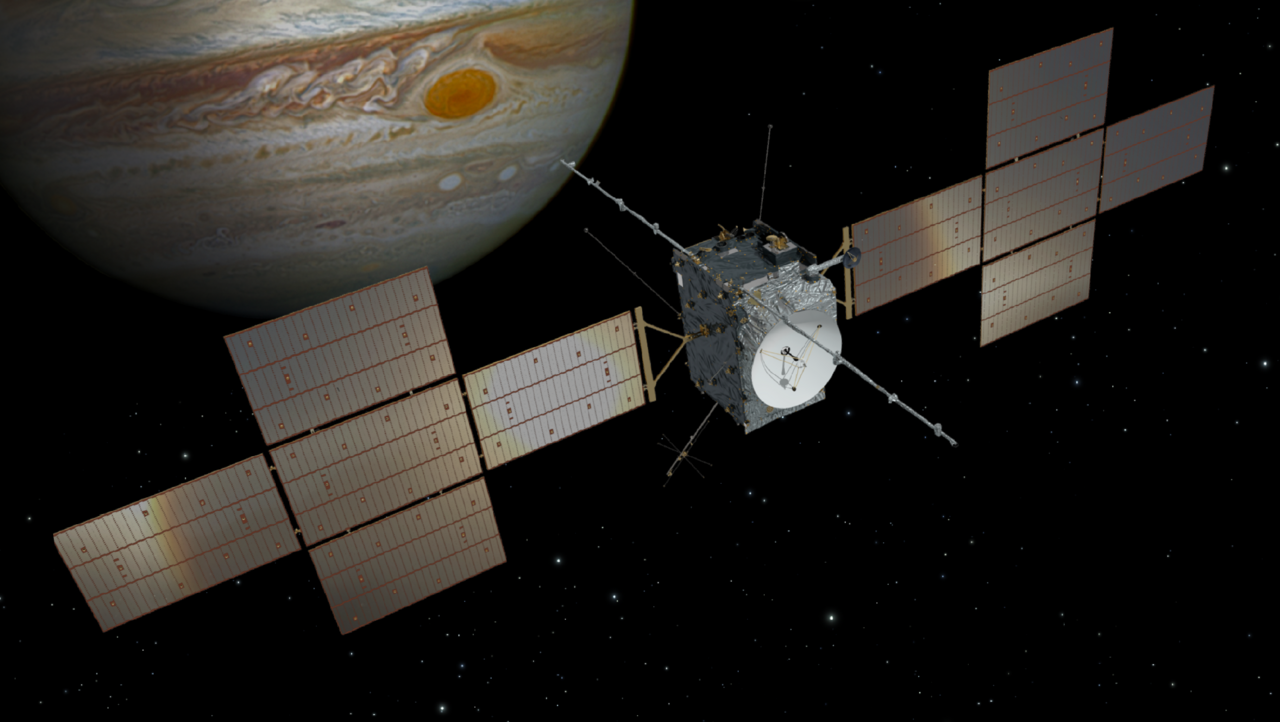
JUICE
Juice (JUpiter ICy moons Explorer) is ESA's flagship mission to the Jupiter system. Launched by Ariane 5 in April 2023, the probe undertakes an eight-year cruise punctuated by gravity assists before reaching Jupiter in 2031, then entering orbit around Ganymede in late 2034. Goal: study three icy moons believed to harbor oceans of liquid water beneath their crust.
Objective
Determine whether Jupiter's icy moons, Ganymede, Callisto and Europa, bring together the conditions for habitability: liquid water, energy and chemistry. Juice will probe the oceans buried beneath their ice and study Jupiter as an archetype of the giant planets, before entering orbit around Ganymede to examine it in detail. Juice does not land: it is an orbiter that observes and measures from a distance.
Mission profile
Simplified diagram of the main phases.
Challenges & risks
Within the program
Galileo (NASA)
First Jupiter orbiter (1995-2003); revealed the clues of subsurface oceans.
Juno (NASA)
In orbit around Jupiter since 2016; probes its interior and magnetosphere.
Europa Clipper (NASA)
Launched in 2024, arriving around 2030; will target Europa, complementing Juice.
Juice (ESA)
This mission, focused on Ganymede and the ocean worlds.
The mission's vocabulary
A maneuver that uses a planet's gravity to change a probe's speed and trajectory without burning fuel.
One of Jupiter's four large moons (Io, Europa, Ganymede, Callisto), discovered by Galileo in 1610.
A body of liquid water kept beneath an ice crust by internal heat and tidal forces.
The questions everyone asks
No. It is an orbiter that studies from a distance. At the end of its life (around 2035), out of fuel, it will crash in a controlled way onto Ganymede.
It is the largest moon in the Solar System and the only one with its own magnetic field; it is believed to harbor a vast ocean of liquid water beneath its icy crust.
No launcher can send a probe this heavy directly to Jupiter; Juice borrows energy from Earth and Venus through gravity assists.
No. It assesses habitability, the presence of liquid water, heat and favorable chemistry, not life itself.
The confirmed elements of the mission (architecture, primary objectives).
The upcoming schedule and milestones, subject to technical qualifications.
The developments dependent on other building blocks of the program.