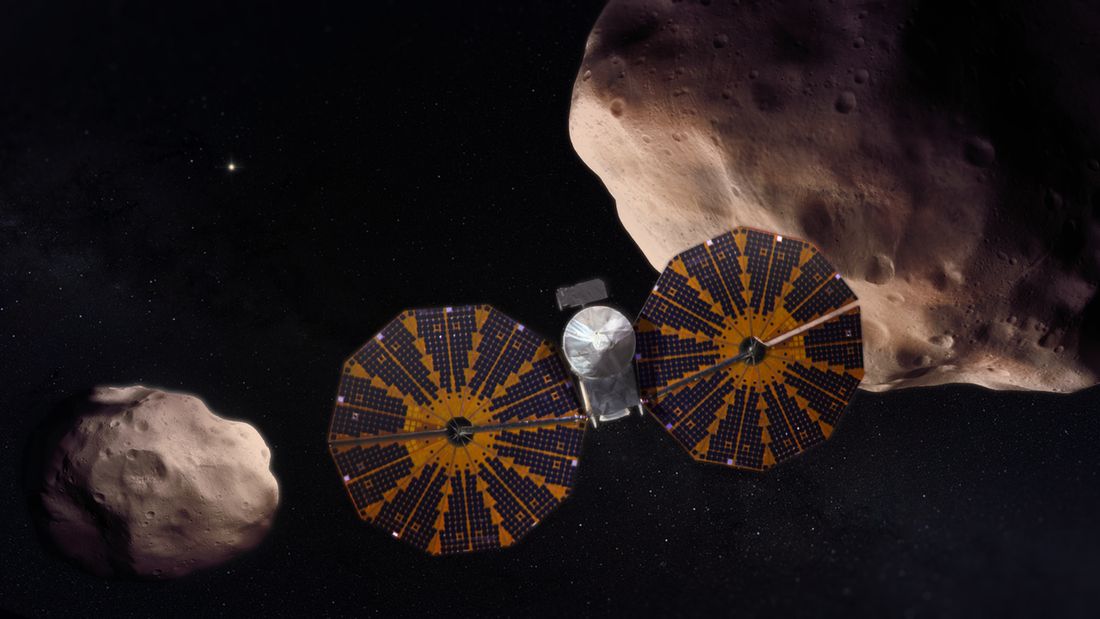
Lucy
A twelve-year tour of the Trojan asteroids, these small bodies trapped on Jupiter's orbit, never visited: Lucy will fly by a record number of them, after cutting its teeth on Dinkinesh (2023) and Donaldjohanson (2025).
Objective
Study up close the diversity of the Trojans, colors, densities, craters, satellites, to reconstruct the history of the formation and migrations of the giant planets. The Trojans are regarded as fossils of the origins.
Mission profile
Simplified diagram of the main phases.
Challenges & risks
The mission's vocabulary
Small bodies that share Jupiter's orbit, clustered 60° ahead of (L4) and behind (L5) the planet.
A gravitational equilibrium position where a small body can remain stable relative to two larger bodies.
The questions everyone asks
In tribute to the Australopithecus fossil Lucy, which shed light on our origins, itself named after the Beatles song. The probe even carries a disk with its lyrics.
Trapped at Jupiter's Lagrange points for billions of years, they have barely changed: they are direct witnesses of the formation of the giant planets.
The confirmed elements of the mission (architecture, primary objectives).
The upcoming schedule and milestones, subject to technical qualifications.
The developments dependent on other building blocks of the program.