Mars Sample Return
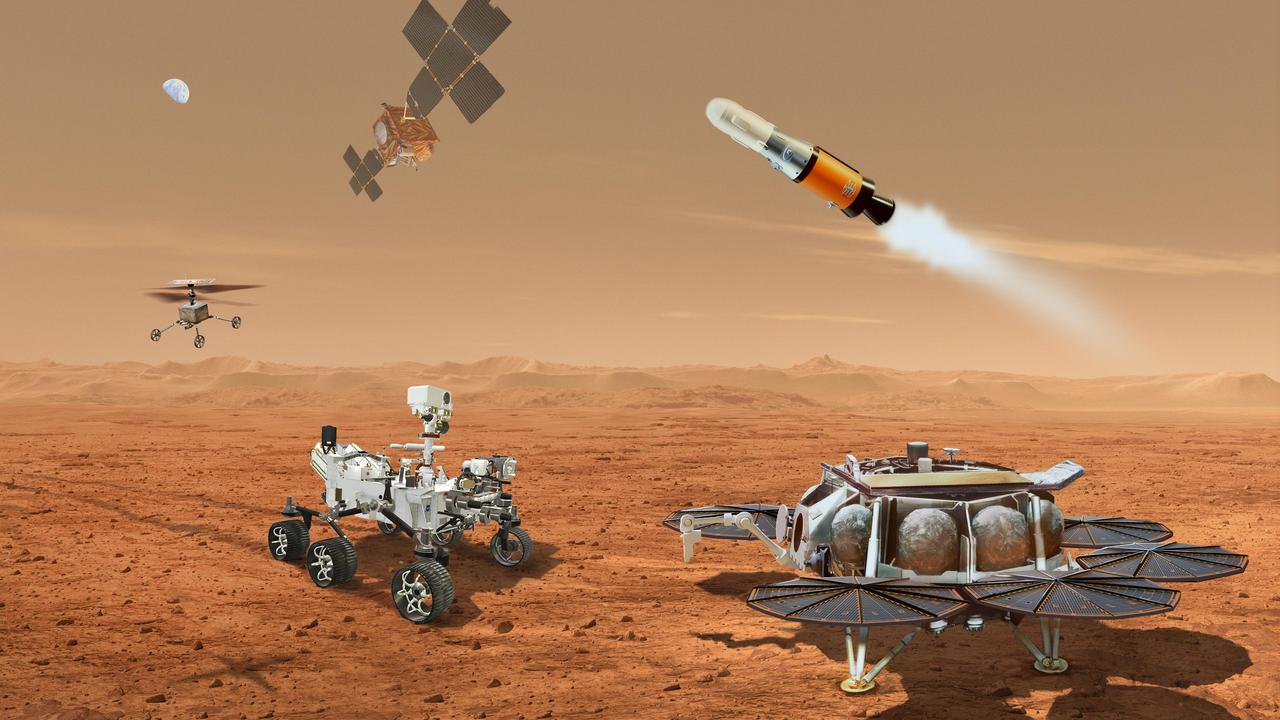
Bringing back to Earth the rock cores collected by the Perseverance rover in Jezero crater, an ancient Martian lake. The undertaking, the most complex ever envisioned in planetary robotics, would chain together a retrieval lander, the first rocket to lift off from the surface of Mars and a European return orbiter. Judged too costly (up to ~11 billion dollars) and too slow (return around 2040), the architecture was reopened to lighter options in 2024. The 2026 US federal budget, however, stopped funding the existing program, favoring instead a more modest 'Mars Future Missions' envelope. The samples themselves remain sealed on Mars, awaiting a possible retrieval mission.
Objective
Bring back to Earth carefully selected Martian samples, sedimentary rocks from an ancient delta, igneous rocks, regolith and atmosphere, in order to analyze them with the precision of major terrestrial laboratories. The central stake: determining whether Jezero could have hosted past microbial life, a question beyond the reach of the instruments carried on a rover.
Mission profile
Simplified diagram of the main phases.
Challenges & risks
Within the program
Mars 2020 / Perseverance
Collecting and caching samples in Jezero since 2021.
Sample Retrieval Lander + MAV
Ground retrieval and liftoff from Mars, architecture not funded by the 2026 budget.
Earth Return Orbiter (ESA)
Return orbiter; lacking US funding, ESA is considering repurposing the vehicle toward another Martian mission.
Mars Future Missions
2026 US envelope intended to prepare future Martian missions.
The mission's vocabulary
Small two-stage rocket designed to lift off from the surface of Mars and place the sample container in Martian orbit.
The set of rules preventing a mission from contaminating another body, or from bringing back to Earth a potentially extraterrestrial contaminant.
A ground cache (here Three Forks, in Jezero) where tubes are placed as a backup, recoverable by a future mission.
The questions everyone asks
The NASA-ESA architecture as committed is no longer funded by the 2026 US federal budget, which favors a more modest 'Mars Future Missions' envelope instead. Sample return remains a priority scientific objective, but with no committed program or schedule to date.
No. Perseverance has already sealed more than 30 tubes, ten of which were placed on the ground at Three Forks as a backup. They remain recoverable by a future mission, and collection continues.
The rover has no way to leave Mars. Bringing the tubes back requires a dedicated lander, a rocket capable of lifting off from Mars and a return orbiter, three vehicles still to be built.
Terrestrial laboratories offer a precision beyond the reach of onboard instruments, and will make it possible to study the samples for decades, with methods still to be invented.
The confirmed elements of the mission (architecture, primary objectives).
The upcoming schedule and milestones, subject to technical qualifications.
The developments dependent on other building blocks of the program.