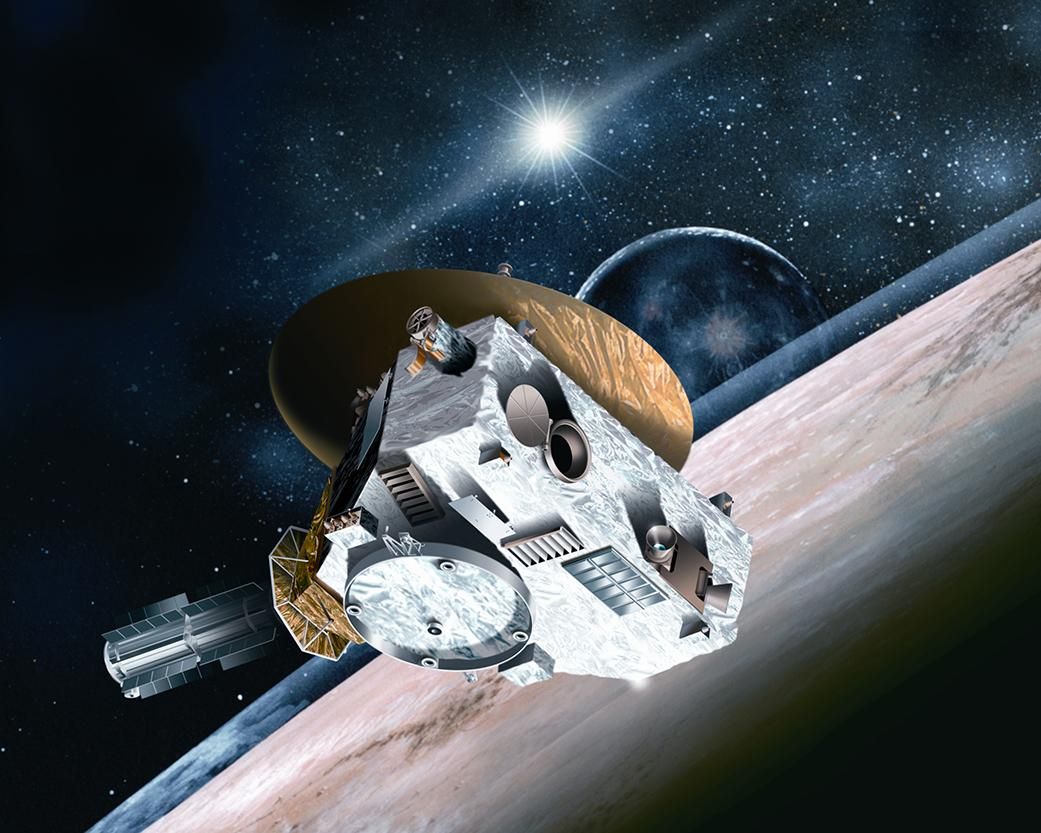
New Horizons
The first probe to visit Pluto, whose nitrogen glaciers and frozen-water mountains it revealed on Jul 14, 2015, New Horizons then flew by Arrokoth (2019), the most distant object ever approached, and continues its exploration of the Kuiper Belt.
Objective
Map Pluto and its moons, understand the geology and atmosphere of this dwarf world, then study up close a primitive object of the Kuiper Belt, an intact memory of the Solar System's formation.
Mission profile
Simplified diagram of the main phases.
Challenges & risks
Within the program
New Horizons
1st mission of NASA's New Frontiers program.
Juno
2nd mission, in orbit around Jupiter.
OSIRIS-REx
3rd mission, sample of Bennu returned in 2023.
The mission's vocabulary
A ring of icy bodies beyond Neptune, a remnant of the Solar System's formation.
An electronic sleep mode that preserves the spacecraft during the long cruises.
The questions everyone asks
In 2006, the IAU defined the term 'planet'; Pluto, which does not dominate its orbit, became a dwarf planet. The richness revealed by New Horizons was all the more striking for it.
It continues on its way through the Kuiper Belt, observes distant objects and measures the environment of particles and dust, while waiting for a possible new flyby target.
The confirmed elements of the mission (architecture, primary objectives).
The upcoming schedule and milestones, subject to technical qualifications.
The developments dependent on other building blocks of the program.