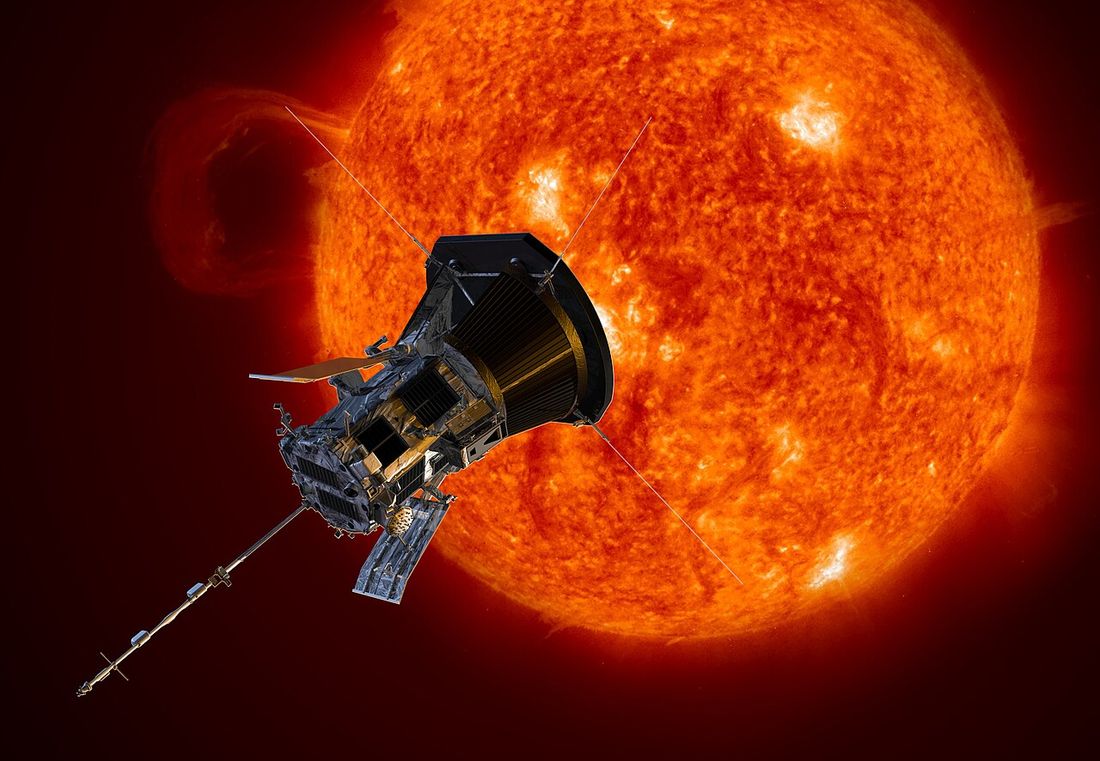
Parker Solar Probe
The first spacecraft to 'touch' the Sun: protected by its carbon shield, Parker flies through the solar corona at record speeds. In December 2024, it passed 6.1 million km from the surface, at about 192 km/s, never seen before.
Objective
Solve two 60-year-old mysteries: why is the corona hundreds of times hotter than the Sun's surface, and how is the solar wind accelerated? The answer: by going to measure on site, in the corona itself.
Mission profile
Simplified diagram of the main phases.
Challenges & risks
The mission's vocabulary
The Sun's outer atmosphere, visible during total eclipses.
The point of the orbit closest to the Sun.
The continuous stream of charged particles emitted by the Sun.
The questions everyone asks
The corona is extremely hot but very thin: it transmits little heat. The carbon shield is enough to protect the spacecraft, which stays behind its shadow.
That is precisely the mystery: the surface is at ≈5,500 °C, the corona at more than a million. Parker's measurements sort out the candidate mechanisms, magnetic waves and reconnections.
The confirmed elements of the mission (architecture, primary objectives).
The upcoming schedule and milestones, subject to technical qualifications.
The developments dependent on other building blocks of the program.