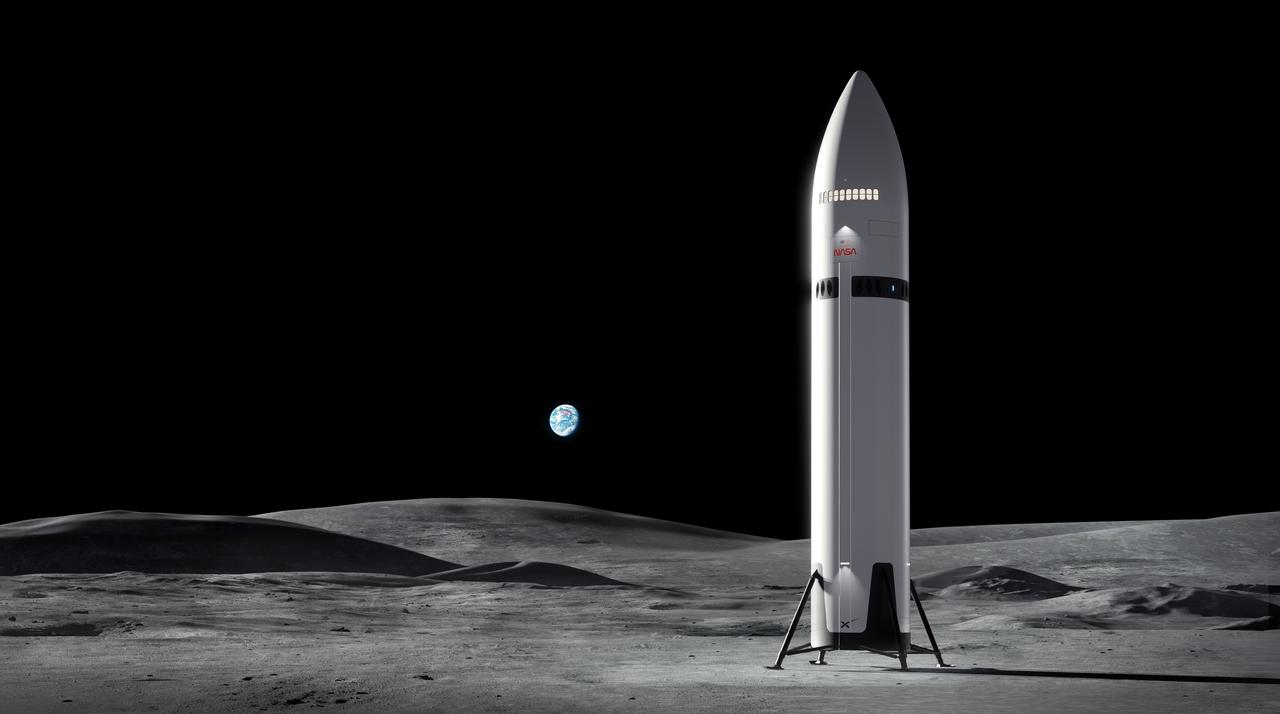
Artemis III
Since the overhaul of the Artemis architecture (February 2026), Artemis III is no longer a lunar landing: it is a crewed demonstration flight in low Earth orbit, targeted for around 2027. The SLS launch vehicle and Orion spacecraft carry four astronauts into Earth orbit to demonstrate, for the first time, rendezvous and docking between Orion and one (or two) uncrewed test version(s) of the commercial landers, Blue Origin's Blue Moon and/or SpaceX's Starship. The first crewed landing near the south pole is now carried by Artemis IV (targeted for early 2028). The crew was named on Jun 9, 2026.
Objective
Validate in Earth orbit the rendezvous, docking and crew transfer procedures between Orion and the commercial landers, before using them around the Moon. The mission must also test Orion's life support on an extended flight and its improved heat shield, following the erosion observed on Artemis I, in order to reduce risks before the first crewed lunar landing, assigned to Artemis IV. It serves as an operational stepping stone between the Artemis II lunar flyby (successful in April 2026) and the landing missions.
Mission profile
Simplified diagram of the main phases.
Crew
Randy Bresnik, commander of Artemis III (crew announced on Jun 9, 2026).
Luca Parmitano, first assignment of an ESA astronaut to an Artemis mission.
Andre Douglas, mission specialist.
Frank Rubio, mission specialist.
Bob Hines, reserve crew member (backup).
Challenges & risks
Within the program
Artemis I
Uncrewed test flight of Orion around the Moon (2022).
Artemis II
First crewed flight: lunar flyby without landing, successful in April 2026 (Wiseman, Glover, Koch, Hansen).
Artemis III
Crewed demonstration in Earth orbit: Orion-commercial lander rendezvous and docking.
Artemis IV
First crewed landing near the lunar south pole, targeted for early 2028; architecture revised after the Gateway was paused (March 2026).
The mission's vocabulary
A crewed lander tasked with carrying the crew from lunar orbit to the surface and back. Two models are in development: SpaceX's Starship and Blue Origin's Blue Moon; Artemis III tests uncrewed test versions of them in Earth orbit.
The maneuvers by which two vehicles come together then mate in orbit. Demonstrating them between Orion and a lander is the central objective of Artemis III.
Near-rectilinear halo orbit around the Moon: highly elongated and fuel-efficient, it will serve as a rendezvous point between Orion and the lander during the landing missions (Artemis IV and beyond) and as the orbit for the Gateway station.
The questions everyone asks
No. Since the overhaul of the Artemis architecture (February 2026), Artemis III is a crewed demonstration mission in Earth orbit: it tests rendezvous and docking between Orion and the commercial landers. The first crewed landing near the south pole is now assigned to Artemis IV, targeted for early 2028.
NASA restructured the program to reduce risks and increase the pace: first validate, in Earth orbit, the Orion-lander rendezvous and docking before attempting these maneuvers around the Moon.
Yes. NASA announced the crew on Jun 9, 2026: Randy Bresnik (commander, NASA), Luca Parmitano (pilot, ESA), Andre Douglas and Frank Rubio (mission specialists, NASA), with Bob Hines (NASA) as backup.
The schedule has slipped several times since the initial 2024-2025 targets. The maturity of the commercial landers and the lessons from previous flights weigh on a target set around 2027. No date is firm.
The confirmed elements of the mission (architecture, primary objectives).
The upcoming schedule and milestones, subject to technical qualifications.
The developments dependent on other building blocks of the program.