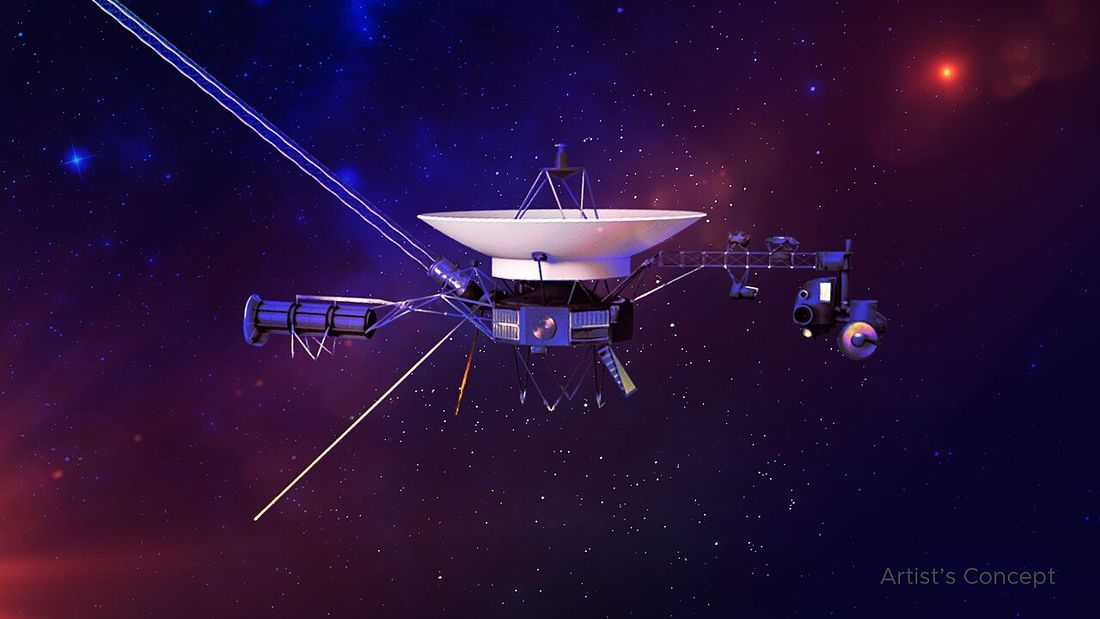
Voyager 1
Launched in 1977, Voyager 1 is the most distant human-made object: after revealing Jupiter, then Saturn and its moon Titan, it crossed the heliopause in 2012 and continues on its way through interstellar space, more than 170 times the Earth-Sun distance.
Objective
Explore Jupiter (1979) and Saturn (1980), with a decisive detour past Titan, then, in extended mission, probe the edges of the heliosphere and the interstellar medium: magnetic field, particles and plasma that no other spacecraft has ever measured on site.
Mission profile
Simplified diagram of the main phases.
Challenges & risks
The mission's vocabulary
The boundary where the solar wind gives way to the interstellar medium: the Sun's 'bubble' ends there.
Radioisotope thermoelectric generator: electricity is produced there by the heat of a radioactive decay.
The questions everyone asks
Instruments are switched off one by one to save power; NASA hopes to keep a scientific contact until around 2030.
Toward the constellation Ophiuchus. In about 40,000 years, it will pass within 1.6 light-years of the star Gliese 445.
An onboard record carrying sounds and images of Earth, selected by Carl Sagan's team, intended for a possible extraterrestrial intelligence.
Launch of the Voyager probes
NASA
Voyager 1 & 2
sonde
Voyager 2
Launched two weeks before its twin, Voyager 2 is the only probe to have flown by all four giant planets: Jupiter, Saturn, then, a world first, Uranus (1986) and Neptune (1989). It reached interstellar space in 2018.
The confirmed elements of the mission (architecture, primary objectives).
The upcoming schedule and milestones, subject to technical qualifications.
The developments dependent on other building blocks of the program.